To Register or Not to Register?
How MISO, SPP, and ERCOT Treat Behind-the-Meter Storage at Data Centers

How MISO, SPP, and ERCOT Treat Behind-the-Meter Storage at Data Centers
Grid operators across the US are actively working out how to integrate a massive buildout of new data centers. One big open issue is how to treat behind-the-meter storage, including the UPS systems that protect data centers from power disruptions. To enable speed to power, many large load owners and operators argue that because these resources sit behind the meter and protections can be put in place to ensure they never export, there is no need for the grid operator to have visibility into the equipment. Grid operators argue that behind-the-meter resources can still affect grid voltage, frequency, and current, even when they aren't exporting power. Those impacts can be measured, which is why operators maintain that they need visibility into how these resources are operating.
Do grid operators require behind-the-meter storage and Data Center UPS to be registered?
While the rules are still being written, efforts like Zero-Injection Generator Interconnection Agreement (ZGIA) in MISO and the High Impact Large Load Generation Assessment (HILLGA) in the Southwest Power Pool (SPP) set out clear frameworks and processes for large loads with behind-the-meter storage. Both establish that these behind-the-meter storage resources at large-load sites need to be registered with the grid operator, which needs at least visibility into them to monitor how they affect its system. The Electric Reliability Council of Texas (ERCOT) recently put out its initial proposal on how to treat different configurations of batteries at Large Computational Load sites on its system. The three configurations are summarized below.
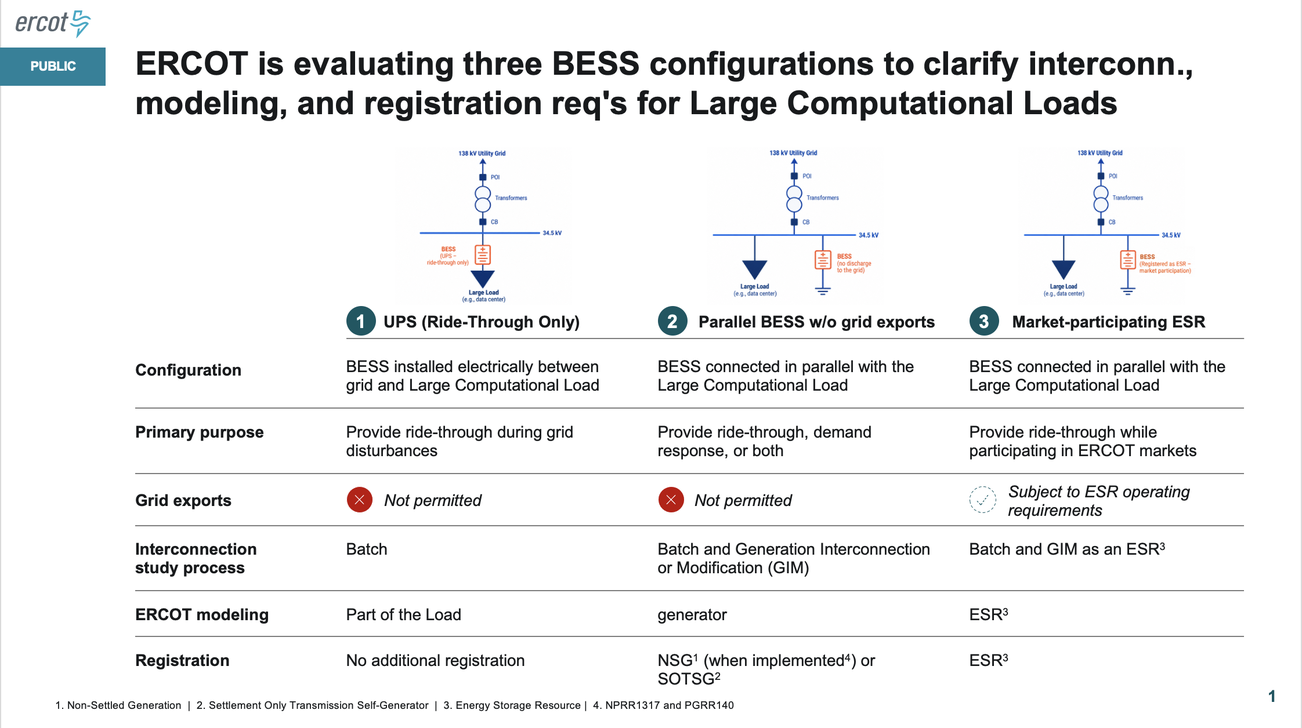
How should a Data Center UPS that shares a power conversion system with the load be registered?
Storage systems that share a power conversion system (PCS) with load, such as ON.energy’s AI UPS™, a medium-voltage, fully inline uninterruptible power system for data centers, don’t neatly fall into either category (load or storage). At ON.energy we believe these resources should simply be treated as part of the load they support when configured to prevent active power from being injected into the grid. Both ERCOT and MISO proposals have adopted this approach. This keeps resource registration consistent with how the grid models the load and equipment, focusing only on the grid-facing power conversion system (PCS). Treating it otherwise could create a situation in which the same PCS and equipment are simultaneously treated as both a load and a storage resource, without a clear way to differentiate “storage” behaviors and measurements from “load” ones.
Can data center UPS systems help stabilize the grid while protecting the facility from power disruptions?
As the rules take shape, this framework will need to evolve to account for how data center equipment can help stabilize the grid while continuing to protect facilities from power disruptions. ON.energy’s AI UPS can provide grid services like demand response, ancillary services, energy, and capacity, while simultaneously ensuring the data center remains compliant with ride-through and other grid requirements. We look forward to working with AI factories, policymakers, and grid operators to mature the models and regulations that make this a reality and enable grid-safe and grid-supporting data centers.